Mermaid Swims Away to Wighton

Now appearing at Undercurrent: North Norfolk Exhibition Project 2026 

at All Saints Church Wighton Norfolk. NR23 1PL.  1st July – 3rd August

For more info:http://www.nnepcontemporaryart.com

I like to take my inspiration from the places where I exhibit, their physical environment and history and the stories about them.

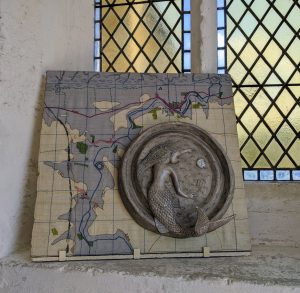
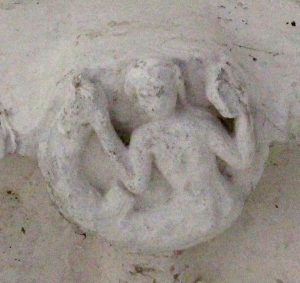
For Undercurrent I have been inspired by the small 15th Century carving of a mermaid, which you can see above the window opposite my piece in the porch of All Saints church. I wonder why the Wighton Mermaid, a mythical character, should appear in the porch? One source suggests that the mermaid symbolises lechery (nakedness) and vanity (on account of her mirror and comb), thus deadly sins to be avoided by good Christians, but that hardly fits this charming little carving. The church is very near the sea and the ancient ports of Holkham and Wells so the maritime connection is strong.  Sheringham church along the coast also has a mermaid carved onto the end of a bench.

I have been playing with the idea of mermaids for many years. They have popped up in several puppet theatre shows I have designed and made, appearing as subversive characters, half-women, half-fishes, classic chimaeras, seductive to humans but often dangerous. As a former archaeologist I have always been interested in prehistory, hence the inclusion in my piece of the Iron Age hillfort of Warham Camp, which can be found a couple of miles down the Stiffkey valley from Wighton, its concentric rings echoing even more ancient cup and ring symbols.

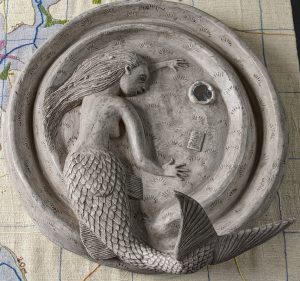
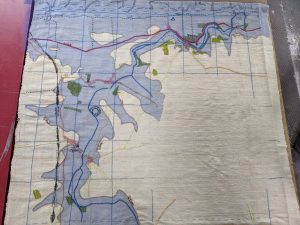
I originally planned just to make a bass-relief depicting the mermaid escaped from the porch and swimming round a ditch of the hill-fort, which I imagined might now be under the sea as a result of climate change. Many undercurrents would be involved, prehistoric, mythological, meteorological and geological.  Then I saw a lovely book on Folk Art* by the Norfolk writer and folklorist Peter Tollhurst (who sadly died this year), and discovered the 19th Century tradition of embroidered maps. By placing my mermaid on a map of the Stiffkey valley and marking the 20 metre contour line I could place her in context and show clearly where the sea-level would be if it rose by 20 metres. So the church and the camp would be below sea-level at some point in the future, allowing our mermaid to swim out of her porch (casting aside her comb and mirror, symbols of vanity) and circle round the fort before heading for the open sea, her proper home.

As a former puppet-maker I have had to use many skills, and sewing is one of them. I based my map on OS Explorer series no. 251 – Norfolk Coast Central. Having grid lines helped me to transfer the map to cloth. The squares on the OS map depict kilometre squares, and by happy accident the ones on my map are exactly 10 x 10 centimetres, so the scale is 1: 10,000.

The cloth is wild silk with a nylon net overlay and the threads are silk and viscose.
The bass relief was cast in Jesmonite and is lightly coloured with acrylic paint.
Many thanks to Tim Hunkin for technical support and installation.

I also realised from reading Peter’s book that I could call myself a folk artist. I am delighted to join that talented group of eccentric outsiders.

* “Smiling at the Storm: East Anglian Folk Art” by Peter Tollhurst 2024: published by Propolis Books and available from The Book Hive, 53 London Street, Norwich. https://www.thebookhive.co.uk

New work for Raveningham Sculpture Trail – Children of Leto

Meg has been working for the past 6 weeks on three new pieces for the Raveningham Sculpture Trail, which opens on Sat 31st August, inspired by the idea of Shelter. Following her own themes of Swan Women and coercion, she thought about how a nest shelters but can be a trap, and about the very fragile shelter of an egg. (read more here)

The new pieces refer to the classical myth of Leto and her children. Raped by the god Zeus in the shape of a swan, Leto becomes pregnant and lays an egg.

Hatching out of the egg are her twin children – the goddess Artemis/Diana who presides over night/the moon and the god Apollo, who presides over day/the sun. Leto has to hide them and keep them safe from Zeus’ wife Hera. In my version of the story, there are two eggs and the twins have some features of their swan father. Placed in the garden at Raveningham, tucked safely under  a hedge, the twins lie sleeping in their egg-shells. Near them, a new manifestation of Infant/Soul – Hatching, has broken out of her own egg and grown wings to fly into a new life.

Originally made in clay…

Artemis

….moulded with silicone, and cast in Jesmonite.

Apollo

Open daily 31st July – 5th Sept, 10-5pm 2021

http://@raveninghamsculpturetrail